
















Discover all our brands







Topwaters
Topwater lures at Charlie's Fishing: poppers, walk the dog pencils, wakebaits, rats and mice
Topwater lures are the surface lures in our shop: lures that float, or run in the top few centimetres, so the take happens where you can see it. Nothing in predator fishing beats a pike erupting under a rat, a shoal of asp slashing at a pencil or a sea bass rolling on a popper in the half light. This page brings our topwaters together and explains how each type works, because a popper, a walk the dog pencil, a prop bait and a wakebait are fished very differently. You find balsa poppers from Rapala and small Swiss poppers from Stucki Fishing, long casting pencils from Rapala and BlueBlue, noise makers from Rapala and Chasebaits, rats and mice from SPRO, Illex and Jackall, a floating big bait, an insect crankbait and the S-curve pencils that swim just under the film. We cover when and where topwater fishing works, from dawn in June to a calm autumn evening, and how to hook a fish that hits on the surface, which is where most topwater takes are lost. For hard lures that run deeper, see Hardbaits; for rats, mice and bucktails in every size, see Mouse & Bucktail Lures.
Poppers: splash and sound to call fish up
A popper has a cupped face. Every short pull of the rod tip pushes a cup of water forward with a pop or a bloop, and in between you let it sit. That rhythm, pop, pause, pop, is what pulls perch and asp up from a few metres down and makes a sea bass commit in a chop. The classic is the balsa Rapala Skitter Pop 7 cm (7 g): a cupped plastic lip, VMC black nickel trebles and a feather dressed rear treble that keeps moving while the lure sits still. You can pop it, bloop it, walk it or skitter it across the surface. The Rapala Skitter Pop 5 cm (6 g) is the same popper for perch and for days when the baitfish are small. The Rapala Skitter Pop Elite (7.5 cm, 10 g) is weighted in the tail, so it casts far and steady and gives loud, deep pops; Rapala designed it for big perch, asp and pike, with VMC 7554 2X black nickel hooks and a feathered tail hook. From Switzerland come two small poppers with a mouth shaped for splash and sound: the Stucki Fishing Bubble 55 (5.5 cm, 7.7 g) for perch, asp and sea bass, and the tiny Stucki Fishing Mini Bubble 35 (3.5 cm, 2 g) for spring and early summer, when the fry are still small and perch hit the surface all day. Fish small poppers on a light rod of about 5 to 20 g casting weight, so you can cast them and feel each pop. More from these brands at Rapala and Stucki Fishing.
Walk the dog pencils: the surface lure that covers water
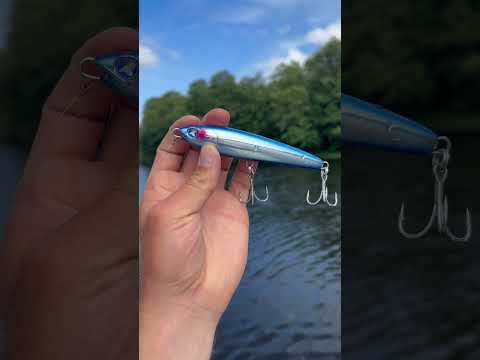
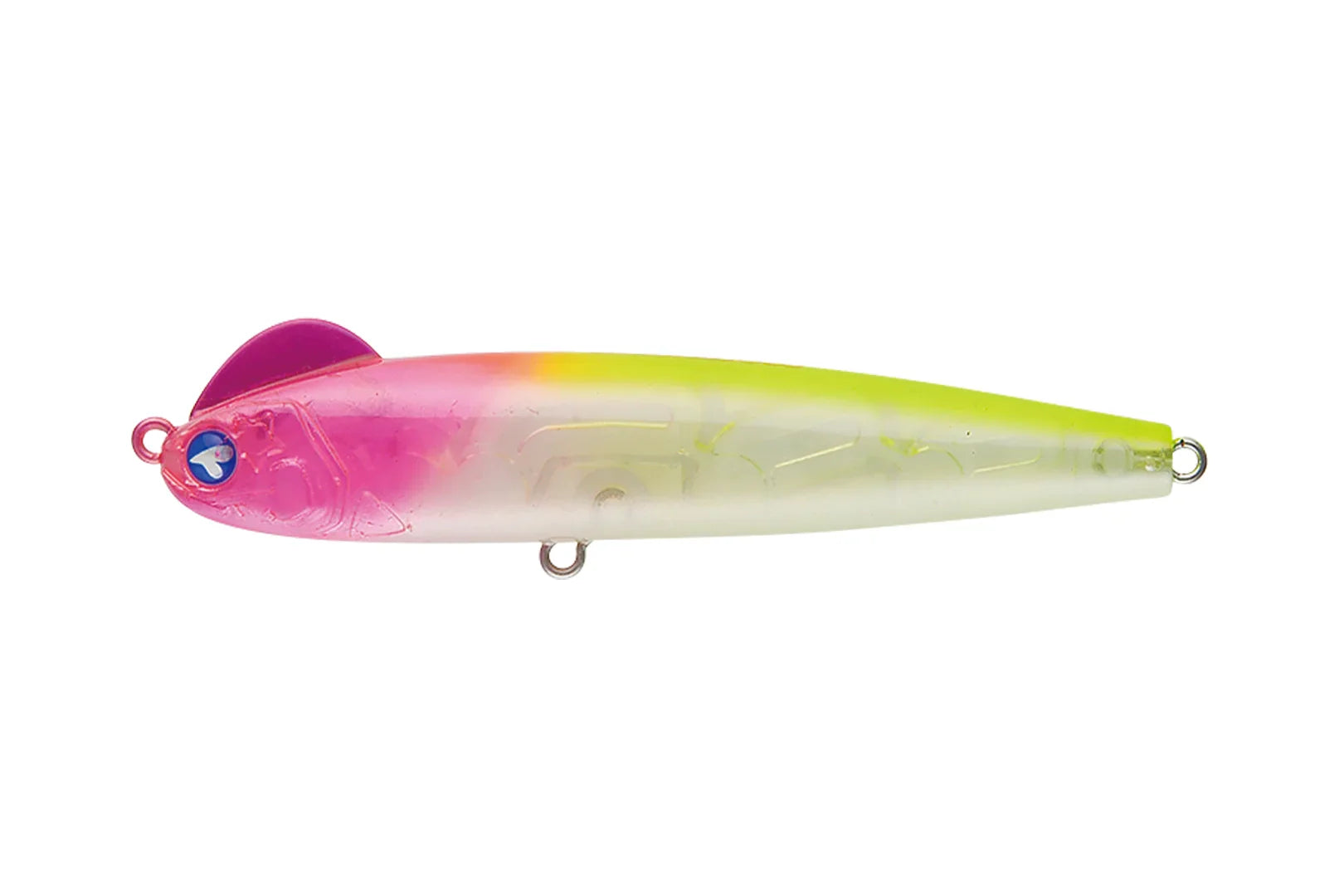
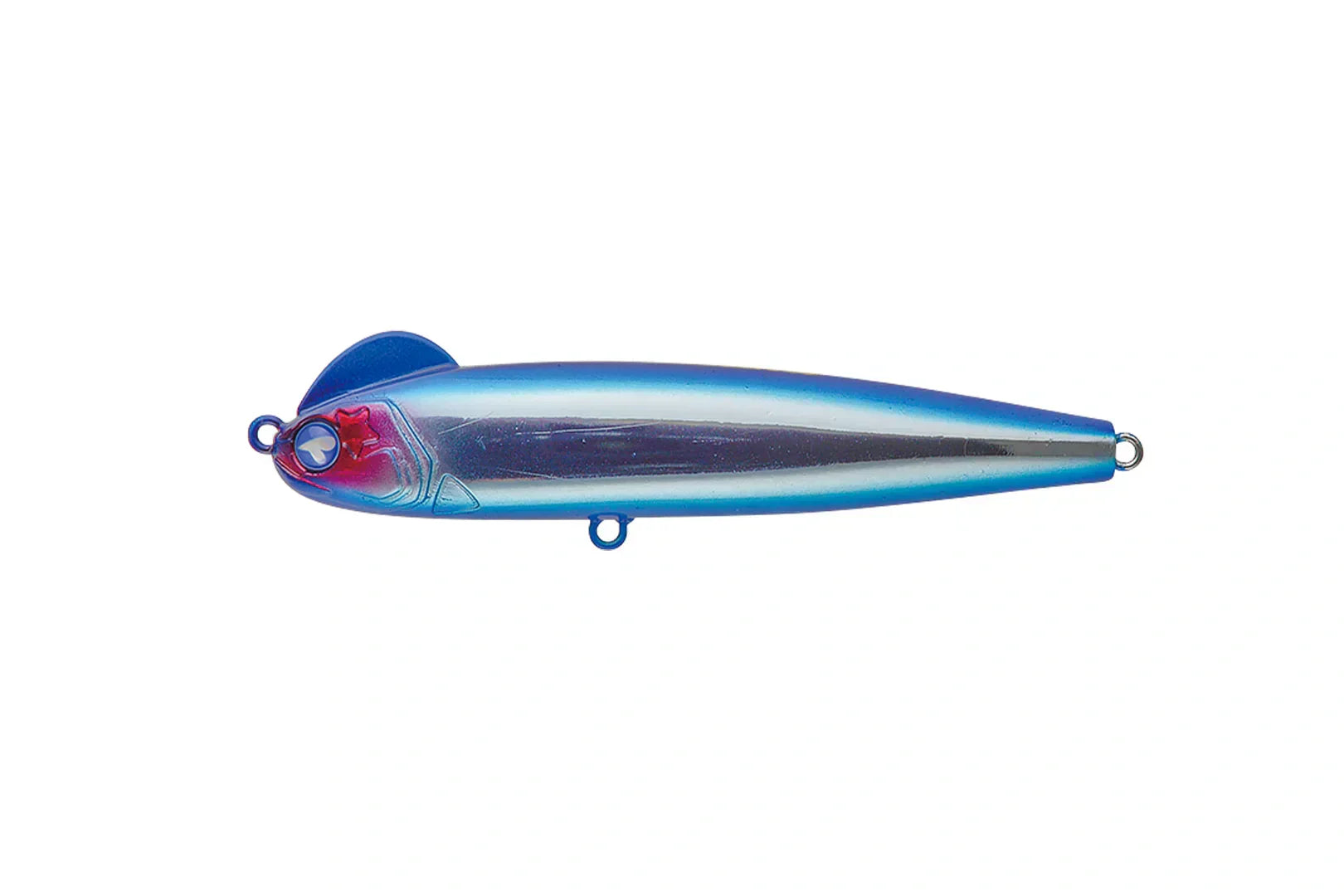
A pencil has no lip and no cup. It floats nose up and does nothing on a straight wind in; the action comes from you. Short, rhythmic twitches of the rod tip on a slightly slack line make it glide left, right, left, right across the surface: walking the dog. A pencil covers far more water than a popper, casts further and is the lure to tie on when fish are chasing bait over a wide area. Our main pencil for sea bass and asp is the Rapala Precision Xtreme Pencil Saltwater (10.7 cm, 21 g): through wired, an internal weight that slides along a rail for very long casts and a stable walk in a crosswind, a Dual Frequency Knocker that gives a high and a low pitch in turn, and two VMC 7548 Ti coated trebles in size 3. The Rapala Precision X-Treme Pencil 87 (8.7 cm, 12 g) is the same pencil one size down, with the same knocker and through wired body, for canals, lakes and smaller baitfish. The Rapala X-Light Pencil (5 cm, 4 g) is the finesse pencil for light tackle, calm clear water and pressured venues, where a subtle walk with pauses gets the cautious fish. From BlueBlue, the BlueBlue Gachipen 130 (13 cm, 30 g) is the big through wired pencil with two size 1 trebles for sea bass on medium sized baitfish and for the biggest pike and asp; it shines in calm water and under fishing pressure, walked with light twitches. The BlueBlue Chupazo 60 (6 cm, 7 g) is a fat little pencil that pushes a lot of water on a slow walk, so fish find it from a distance and you can keep it in the zone without moving far, and the BlueBlue Inemun 60 (6 cm, 6 g) is its subtle sister for calm, pressured water and followers that will not commit. The Jackall Slick Bait (12 cm, 15 g) walks differently: a jointed elastomer tail, silicone gill strips and glass beads give a slow slide walk with a soft rattle, and because you run the line through the body you can set it to slide left or right, which is useful along a jetty or a weed edge. Read how four BlueBlue lures did in Dutch water in BlueBlue Fishing Japan: four lures we tested in Dutch waters, and see all pencils at BlueBlue Fishing and Jackall.
Prop baits and noise makers: Claptail, Smuggler and Drunken Mullet
Some surface lures make their own commotion on a plain retrieve, which makes them the easiest topwaters to fish and the best choice in wind or coloured water. The Rapala Claptail 110 (11 cm, 25 g) has a rotating tail blade that produces a sharp, two toned clapping sound as soon as you start winding, and it tracks straight at slow to medium speed. Its 25 g casts a long way into a headwind, so it is a pike lure for open flats and reed lines on a summer evening and for autumn chop. The Chasebaits The Smuggler (9 cm, 41 g) is a rattling walker shaped like a swimming bird, with a long trailing tail and wings that splash and bloop as it walks, on ultra strong BKK trebles; big pike eat birds, and the Smuggler is the lure for the shallow bays where you see them do it. The Chasebaits Drunken Mullet JNR (7 cm, 11 g) has a double pop and fizz tail and a slim body that skims across the surface at any speed, with BKK hooks that handle both fresh and salt water. Vary the speed: a slow fizz along a weed edge for perch and pike, a fast skim for asp and sea bass. More at Chasebaits and Rapala.
Wakebaits, rats and mice: a V-wake over weed and along the margins
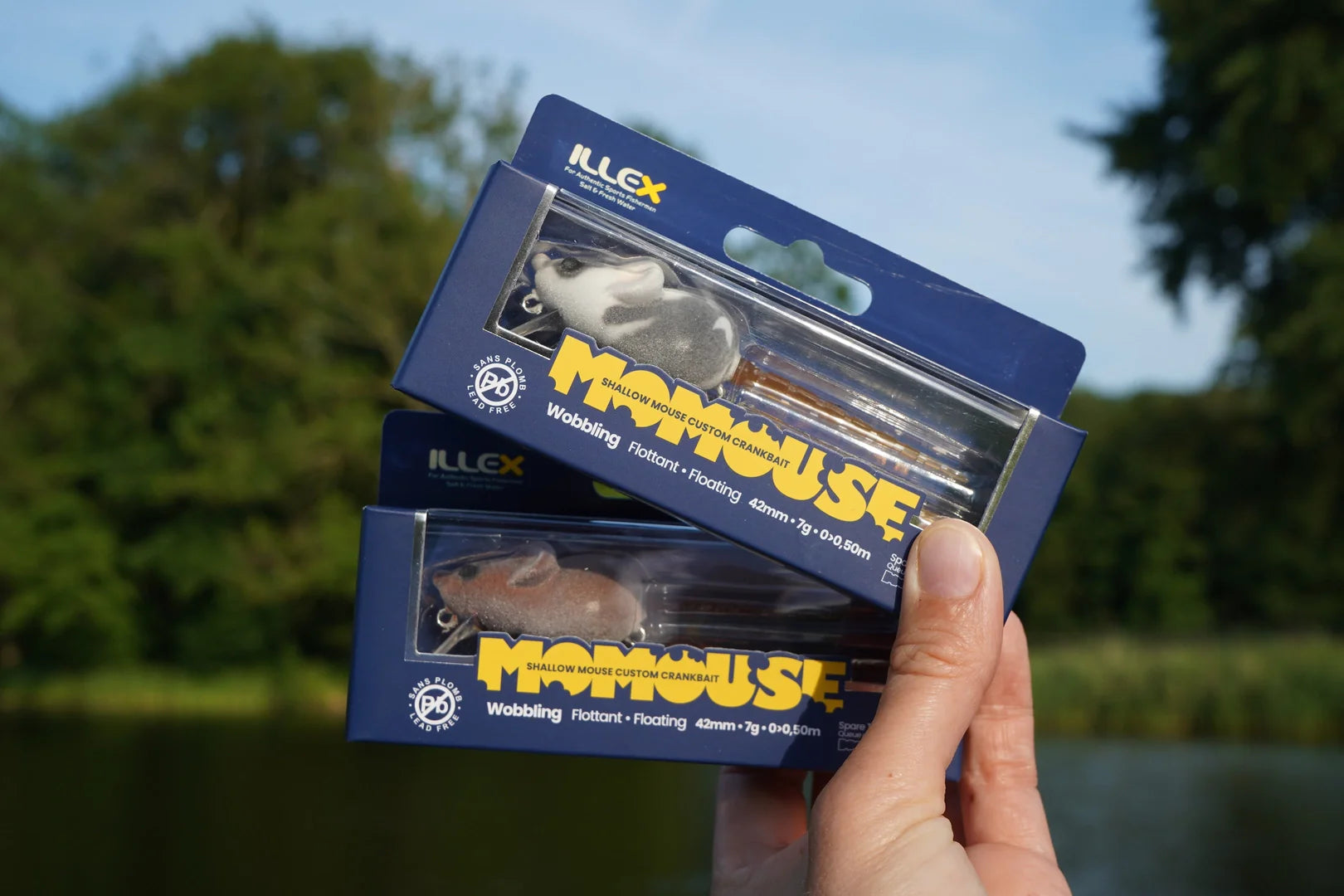
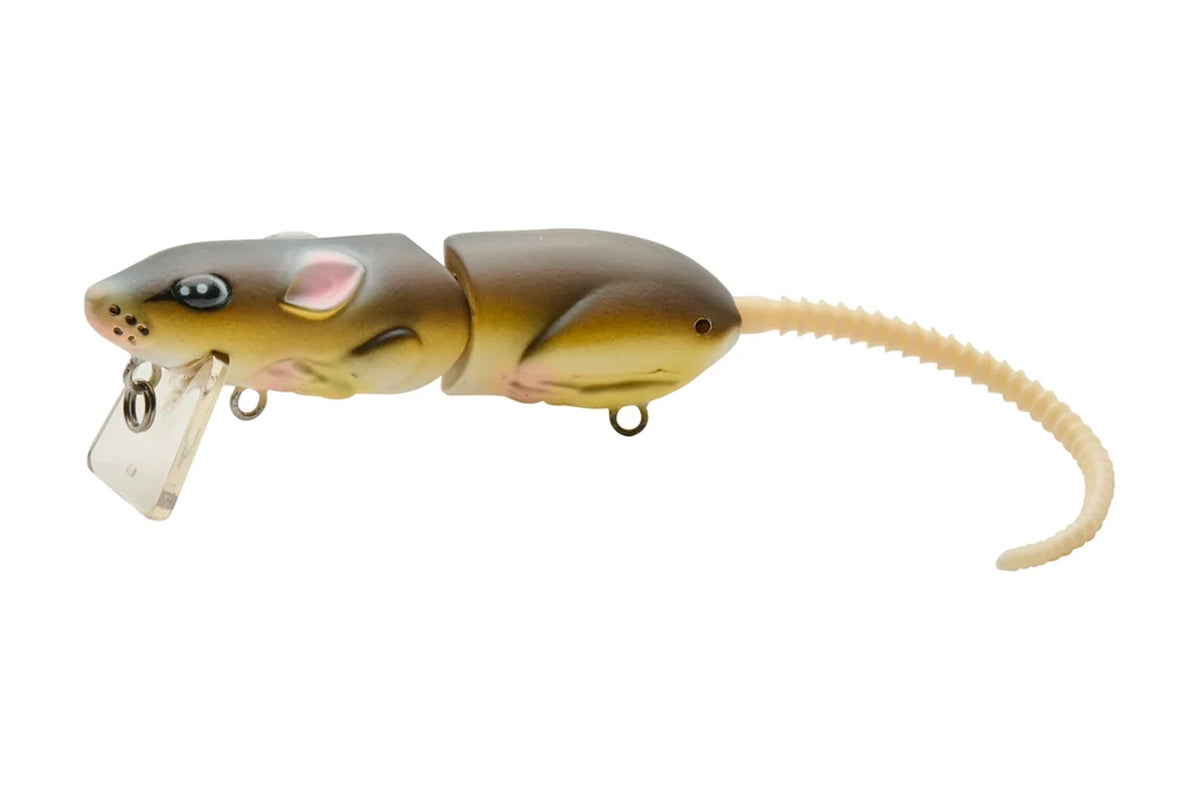
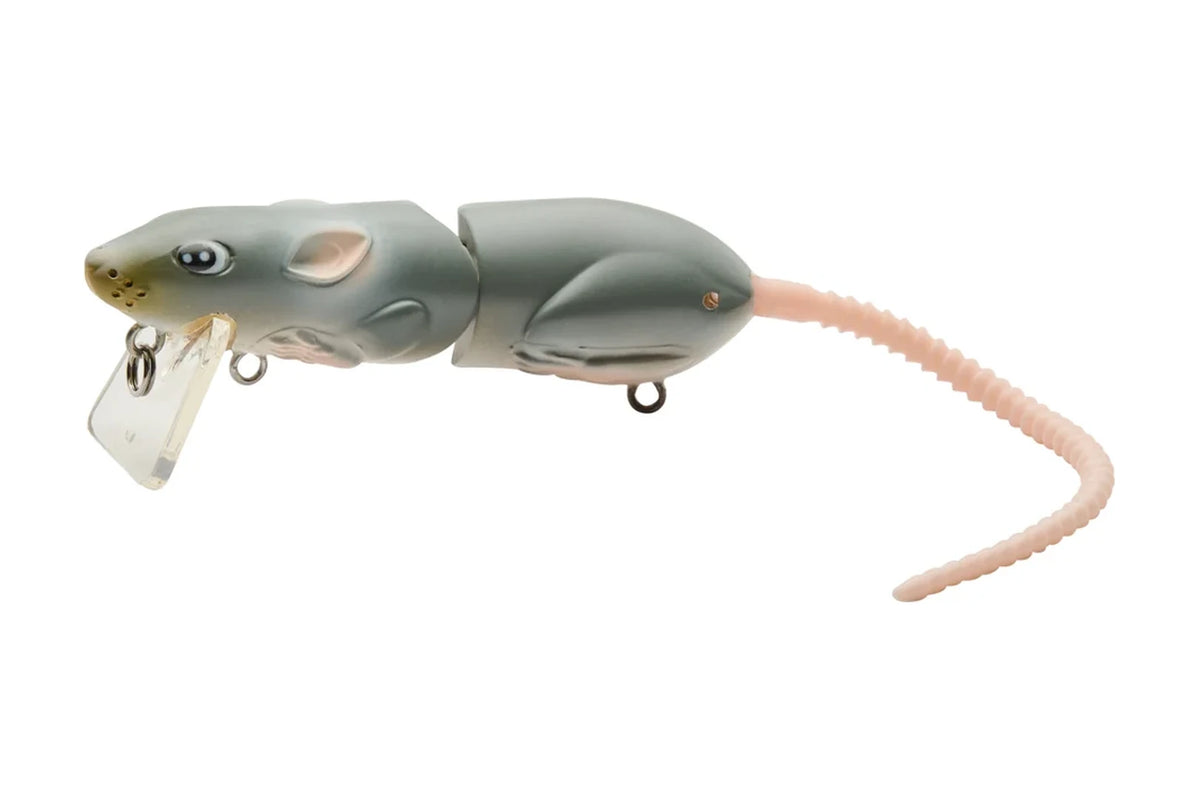
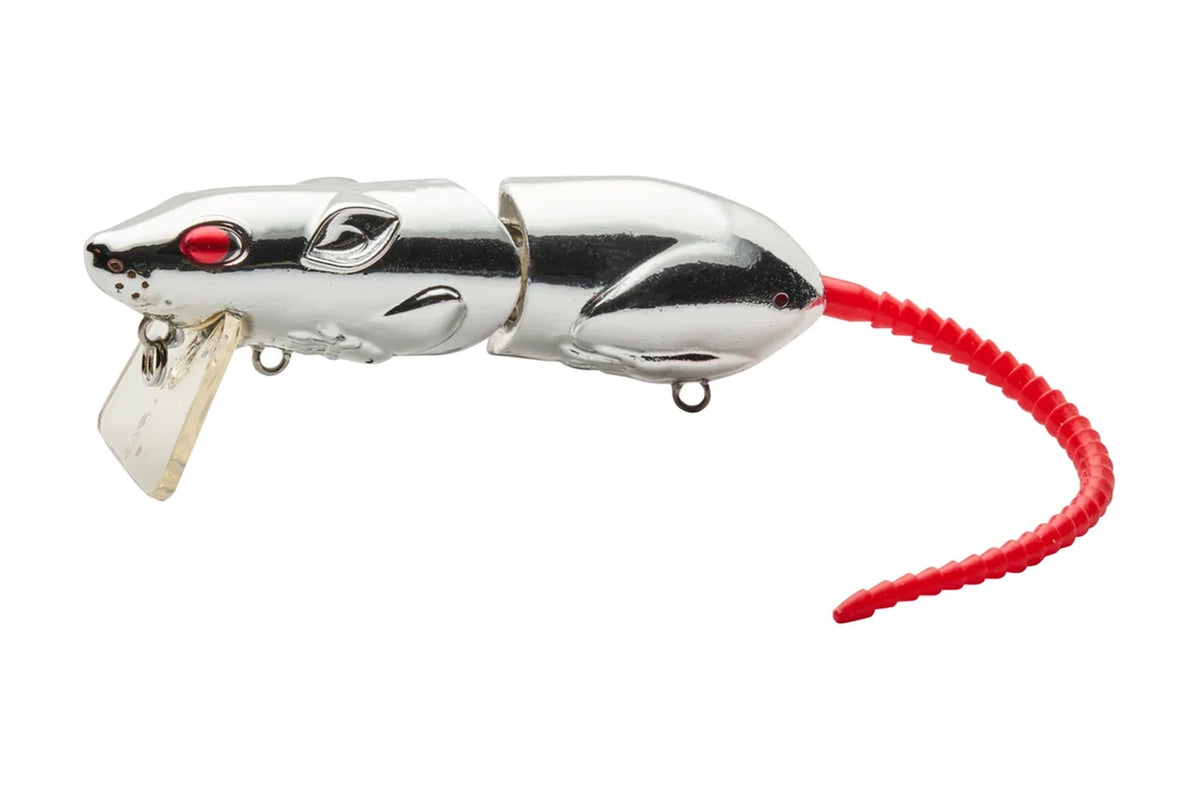
A wakebait is a lure that swims just in the surface film on a slow, steady retrieve and pushes a V-shaped wake ahead of it. Pike in weedy shallows do not need to see the lure; they feel the wake and come up through the weed to take it. The Spro BBZ-1 Rat 50 (13.5 cm body, 25 cm with tail, 60 g, 1/0 hooks, spare tail included) is our pike rat: a jointed body that glides wide on a steady retrieve, and with short rod twitches it changes direction, pops or walks the dog, so one lure covers three surface techniques. Fish it slowly along reed beds, over weed beds and around structure in calm water and low light. The Jackall Flat Bone Clicker (22 cm, 48 g, floating, 0 to 0.3 m) is a jointed floating big bait with a lip and a long elastomer tail: on a straight retrieve it rolls hard just under the surface, and worked with the rod tip it walks the dog without drifting far off line, which lets you keep a big profile next to a snag or a reed edge for pike that want a clear target. For light tackle, the Illex MoMouse (42 mm body, 92 mm tail, 7 g, 0 to 0.5 m, spare tail included) is a compact floating mini wakebait: an ABS body, a supple tail and a small lip give a distinctive wobble with strong vibration. Fish it slowly for a clear wake along banks, stone groynes and tight corners for perch, pike, trout and chub, or speed it up with the rod tip low to trigger followers. The Chasebaits Wiggle Bomb 35 (35 mm, 8 g, two per pack) is the odd one out: a slow sinking TPE creature bait with a wiggling tail and kicking legs, pre rigged on a double weedless hook. Keep the rod tip high and it fishes like a wakebait through the thickest weed, where a treble hooked lure would be stuck in seconds; let it fill with water and it fishes deeper. We do not stock a hollow body frog at the moment, so for pike and perch in heavy weed the Wiggle Bomb is our weedless pick. And when fish are feeding on insects under overhanging trees, the Jackall Chubby Bug 35 (35 mm, 3.7 g) is a floating super shallow crankbait with a beetle profile and silicone legs on two levels: the upper ones twitch on the surface while the lure sits still, the lower ones work under it. Cast it under the branches, leave it for a few seconds, then crawl it: chub, trout and perch take it on the pause. See Mouse & Bucktail Lures, SPRO, Illex and Jackall.
Just under the surface: S-curve pencils and stickbaits for the top half metre
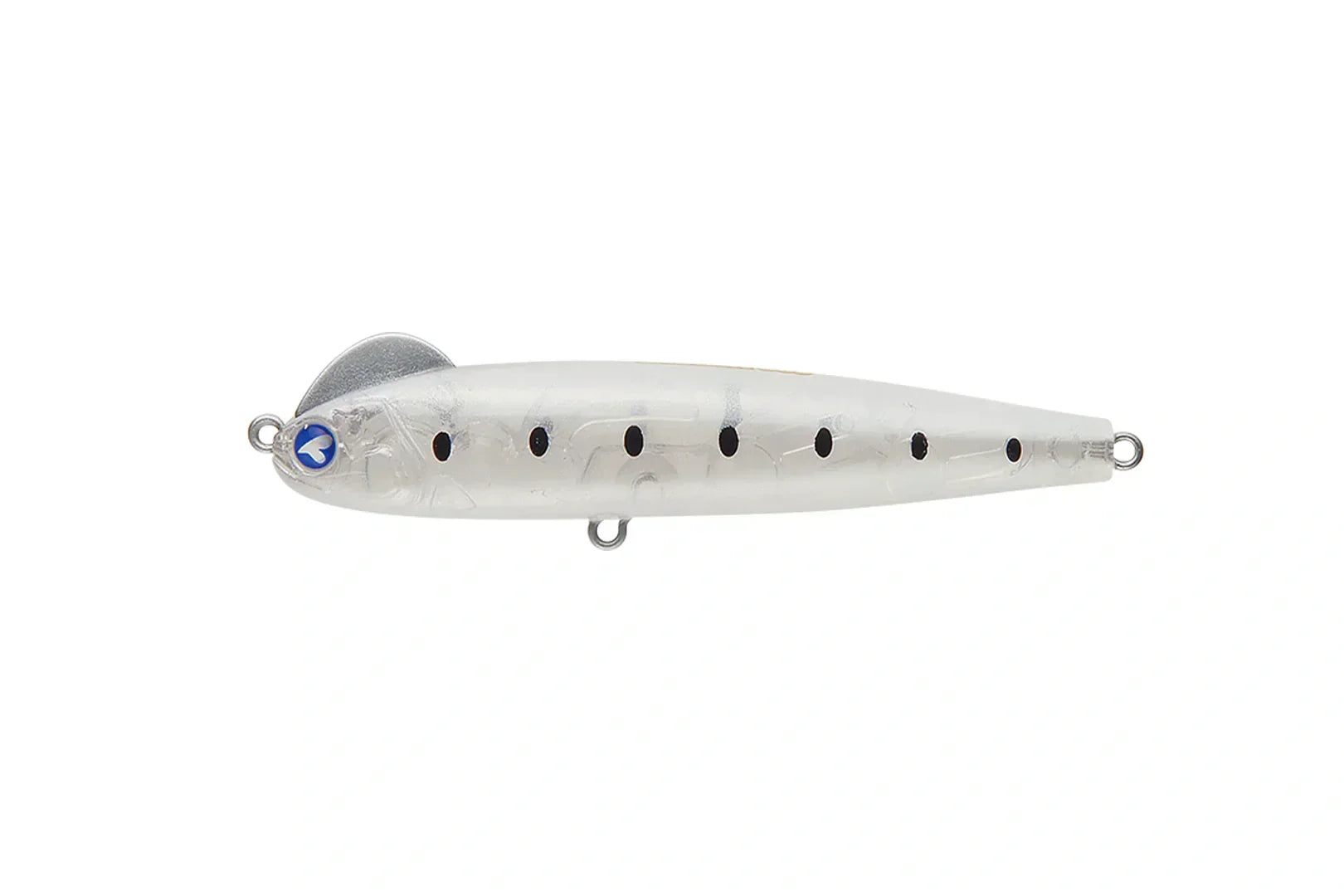
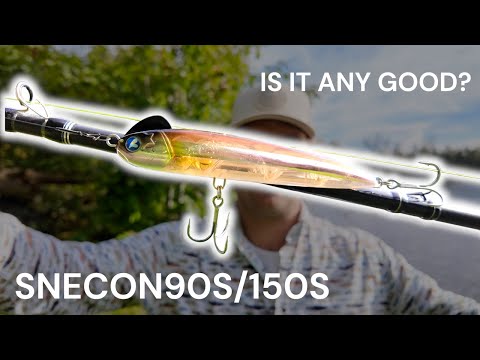
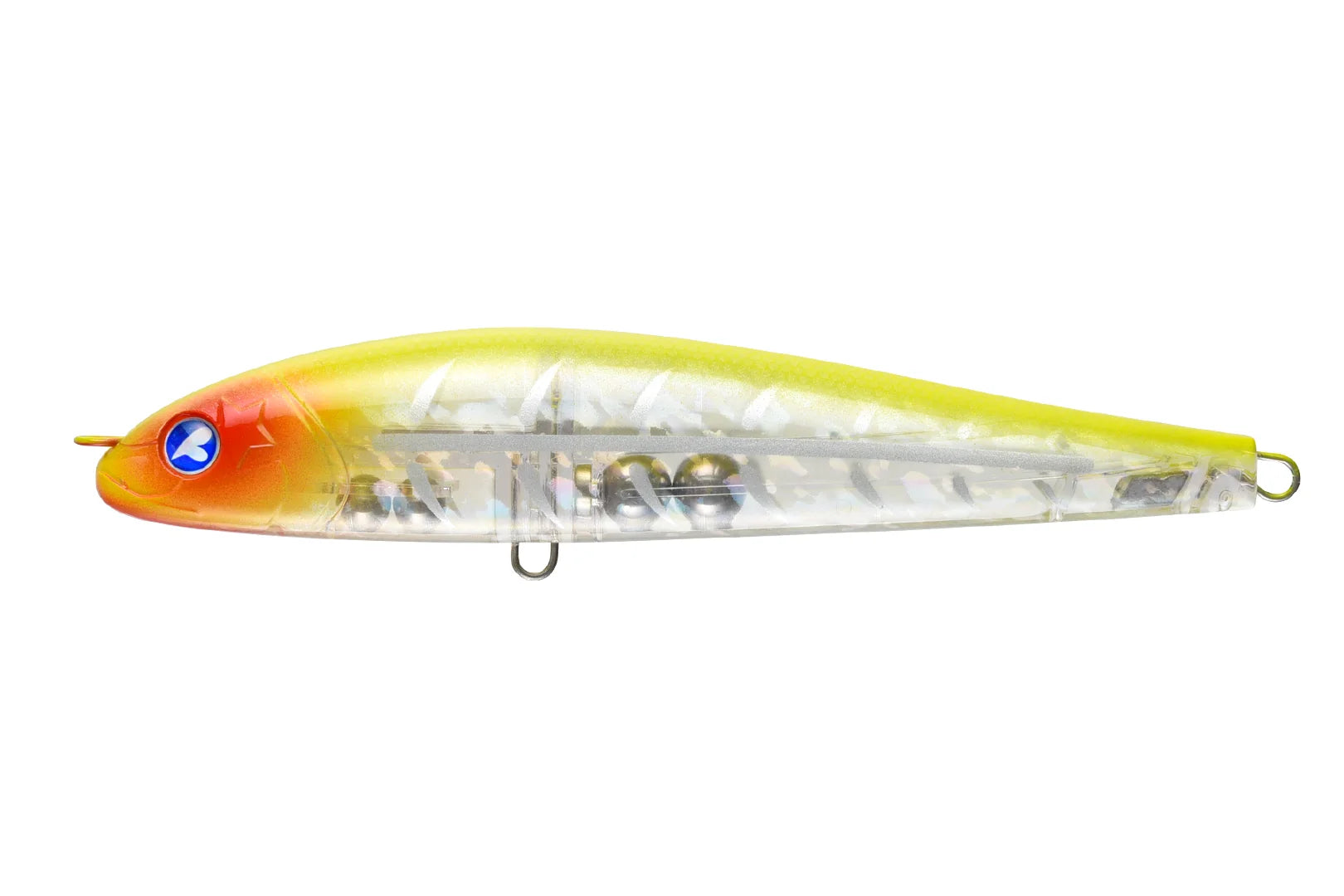
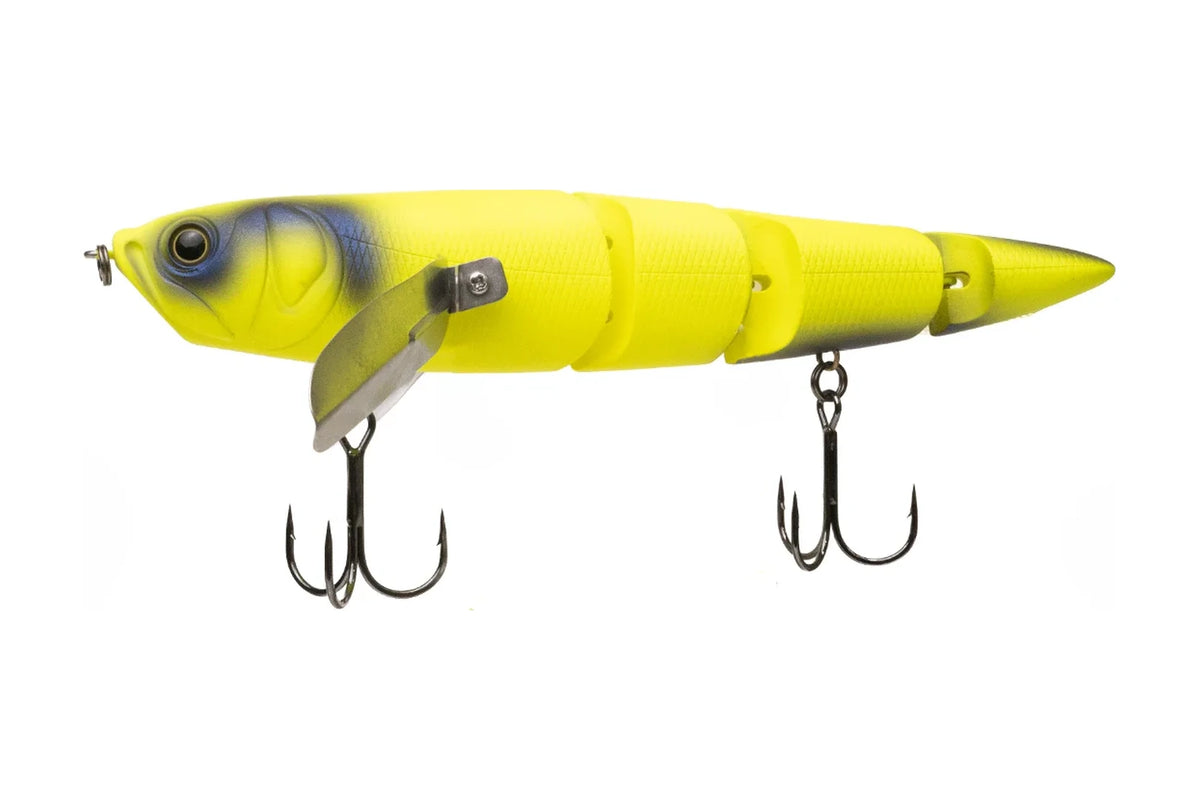
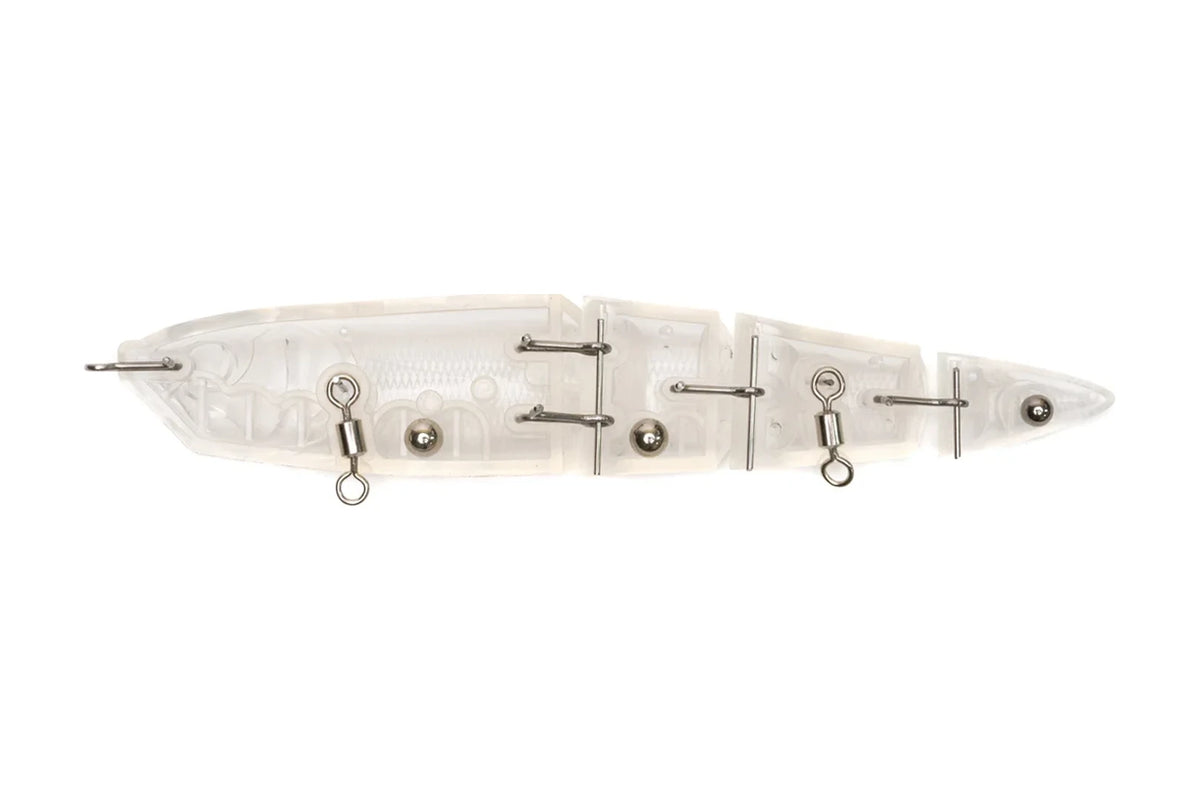
When fish boil at the surface but refuse a lure on top, drop a few centimetres. The BlueBlue Force Guile 160F (16 cm, 50 g) is a floating diving pencil that swims a wide serpentine S-curve just under the surface on nothing more than winding, with a 1.2 mm through wire and a magnetic moving weight for long casts. Long sweeps of the rod make it bob under the film in wide S-curves that push a lot of water, short jerks give a quick S-action; it floats almost level at rest, so a fish that follows it to the surface finds the hooks. It comes without hooks: fit two 2/0 trebles on size 5 split rings. The sinking BlueBlue Snecon 90S (9 cm, 15 g) and BlueBlue Snecon 150S (15 cm, 40 g) have a stepped head and free moving weight balls, so they swim in irregular S-curves that are never the same twice. Start the retrieve the moment they land and keep the rod tip up and they slide and dart just under the surface; stop, and they sink through the layer where the fish are. The 90S is the size for sea bass and asp in current, the 150S for big pike and zander on open water and for sea bass on larger bait. The BlueBlue Arvin 150S (15 cm, 40 g) is a sinking stickbait with a subtle roll and wobble that you can also run just below the surface with the rod tip up, a quieter option for clear water and pressured fish. More S-curve and subsurface lures in Swimbaits & Glidebaits and Seabass Hardbaits.
When and where to fish topwater lures: dawn, dusk, summer and weed
Topwater fishing is at its best from late spring to early autumn, when the water is warm, the weed is up and the baitfish are in the shallows. The best hours are the first two after dawn and the last two before dark, and a warm, overcast day with a light ripple can fish all day long. Flat calm water is where a subtle pencil or a small popper wins; a chop or coloured water asks for a prop bait, a loud popper or a rat that fish can hear and feel. Shallow water is the rule: flats of one to two metres, reed lines, lily pads, weed beds, harbour walls and the edges of channels. In weed, the surface is often the only place you can fish at all: a floating lure stays above the stems where every other lure fouls. Per species: pike in summer sit in weedy bays and along reed beds and hit a rat, a wakebait or the Claptail at dawn and dusk; in autumn the biggest fish come up for a big profile on a calm evening. Perch chase fry to the surface from late spring into summer, often in packs along harbour walls and canal banks, and want a small popper or the X-Light Pencil fished fast with short pauses. Asp hunt in open river water by sight, splash at bait along groynes, weirs and bridge piers and need a long cast and a fast walk; see our Asp page. Sea bass feed on the surface at dawn, dusk and on a flooding tide over flats, rock marks and estuary edges, when sandeel and mullet fry get pushed up; a walked pencil or a popper in a chop gets them, and Seabass and Seabass Hardbaits hold the whole saltwater range. Trout and chub in small rivers take a MoMouse or a Chubby Bug under the trees. For more technique, read Topwater fishing for pike, perch and asp: techniques and best surface lures and River fishing: 9 lures we always bring for perch, zander and pike.
Setting the hook on a surface take
More fish are lost on topwater than on any other lure, and almost always for the same reason: the angler strikes at the splash. A fish that hits a surface lure often misses it, or pushes it aside with the bow wave, and if you strike at that moment you pull the lure out of its reach. The rule is simple: do not react to what you see, react to what you feel. Keep the rod tip low and pointed at the lure, keep walking or popping through the boil, and only when the line tightens and you feel weight do you sweep the rod sideways. If the fish misses, pause the lure for a second and start it again; a pike or a bass that has committed will usually come back for a second go, and if it does not, a quick follow up cast with a subsurface lure such as the Snecon or the Arvin often gets it. Fish braid of 0.12 to 0.20 mm so you can see the line and set the hook at distance, with a fluorocarbon leader of 0.40 to 0.60 mm for perch, asp and sea bass and a titanium or wire trace or a thick fluorocarbon leader of about 0.80 to 1.00 mm for pike; a short leader keeps a small popper walking cleanly. Check the trebles: sharp, strong hooks matter more on topwater than anywhere, because the fish is often hooked on the outside of the mouth. Replacement trebles and split rings are at BKK Hooks and VMC, traces and leaders at Lines and Leaders.
Which topwater lure for which situation
• Flat calm at dawn, cautious fish: Rapala X-Light Pencil, BlueBlue Inemun 60, Rapala Skitter Pop 5 cm.
• Fish chasing bait over a wide area: Rapala Precision Xtreme Pencil Saltwater, Precision X-Treme Pencil 87, BlueBlue Chupazo 60.
• Chop, wind or coloured water: Rapala Skitter Pop Elite, Rapala Claptail 110, Chasebaits Drunken Mullet JNR.
• Pike in weedy bays and along reed beds: Spro BBZ-1 Rat 50, Chasebaits The Smuggler, Jackall Flat Bone Clicker.
• Heavy weed, nothing else can be fished: Chasebaits Wiggle Bomb 35 on its weedless hook.
• Perch on small fry in spring and summer: Stucki Fishing Mini Bubble 35, Stucki Fishing Bubble 55, Rapala Skitter Pop 5 cm.
• Asp on the big rivers: Rapala Precision Xtreme Pencil Saltwater, Rapala Skitter Pop Elite, BlueBlue Snecon 90S.
• Sea bass over flats, rocks and estuaries: Rapala Precision Xtreme Pencil Saltwater, BlueBlue Gachipen 130, Stucki Fishing Bubble 55.
• Fish boiling but refusing the surface: BlueBlue Force Guile 160F, Snecon 90S or 150S, Arvin 150S.
• Small rivers, perch, trout and chub under the trees: Illex MoMouse, Jackall Chubby Bug 35, Jackall Slick Bait.
See also Pike, Perch, Asp, Seabass, Trout and Chub.
Why buy topwater lures at Charlie's Fishing
We are based on the Dutch coast, with the polders, canals and big rivers for pike, perch and asp on one side and the North Sea for sea bass on the other, and the topwaters on this page are the ones we picked for those waters: a popper, a pencil, a prop bait and a wakebait for each species and size of baitfish, from a 2 g Mini Bubble to a 60 g rat. Every lure ships from our own stock in the Netherlands with fast delivery across Europe, and if you are not sure which pencil or popper fits your water, ask us. For more on the Rapala range, read Rapala: which baits to use and when; for every hard lure type, start at Hardbaits and Pike Hardbaits.
What is the best topwater lure for pike?
For pike in weedy shallows a wakebait or rat is the surest choice, because pike feel the wake and come up through the weed: the Spro BBZ-1 Rat 50 fished slowly along reed beds, or the Jackall Flat Bone Clicker when you want a big profile. On open flats and in a ripple, the Rapala Claptail 110 makes enough noise to pull pike from a distance on a plain retrieve. In calm water at dawn, a big walked pencil such as the BlueBlue Gachipen 130 is the lure for the largest fish.
When is the best time to fish topwater lures?
From late spring to early autumn, in warm water, and above all in the first hours after dawn and the last before dark, when predators hunt in the shallows. Calm or lightly rippled water is ideal, and a warm overcast day can fish all day. In spring, when the fry are small, go small: a 2 g Mini Bubble or a 5 cm pencil. In late summer and autumn, when pike and sea bass feed on bigger prey, a 10 to 13 cm pencil, a rat or a big floating bait selects the bigger fish.
Why do fish miss a topwater lure, and how do I hook more of them?
Predators attack a surface lure from below and often misjudge it, so a splash is not always a take. Keep the rod tip low, keep the lure moving and strike only when you feel the weight of the fish, never at the splash. If a fish misses, pause briefly and start the lure again; most come back. Fish sharp, strong trebles and a leader that suits the species, and change to a subsurface lure such as the BlueBlue Snecon when fish keep boiling without taking.